City of London launches £4.3 billion tender • Vital Energi acquires biomass facility • £25m River Clyde Fund launched • Read more about the developments in sustainable heating and cooling in this month's news update from the UK



The City of London Corporation has officially begun a £4.3 billion tender process to secure a private development partner to design, build, and operate a flagship low-carbon heat network across the Square Mile. The initiative aims to supply around 1.200 buildings, relying heavily on the River Thames as a strategic source of heat. Under a 42-year concession, a single partner will create a Special Purpose Vehicle (SPV) to take the network from design and development through construction and operation, while the City retains a “golden share” to safeguard governance and key decisions.
Recent modelling estimates the combined annual heat demand of the 1.200 buildings at roughly 1.000 GWh, with capital expenditure for the core network projected at £1.26 billion. When fully realised, the total system value is expected to exceed £4 billion over the life of the concession. The river Thames will play a significant role, acting as a direct heat source for large water-source heat pumps and offering a route for major heat mains running along the waterfront.
Longer-term plans rely on three industrial-scale sources: waste heat from Tower Hamlet data centres, waste heat from Thames Water’s Beckton Sewage Treatment Works, and Cory’s Riverside Energy Park in Belvedere. Procurement milestones are well-defined, with applications closing on 26 January 2026, interim tenders in March, final tenders in June, and a preferred bidder announcement scheduled for November 5, 2026.
Read more in article from Construction Enquirer
Vital Energi has acquired the Port Clarence biomass power plant in Teesside, marking the next stage of its growth as both a solutions provider and asset owner. The acquisition follows the company’s successful £175 million Nordic Bond issue, one of the largest Sterling-denominated Nordic Bond raises in the UK energy infrastructure sector. The biomass power plant was purchased from Nuveen Infrastructure / Glenmont Infrastructure and represents a significant step in scaling the company’s biomass portfolio in the UK.
The acquisition builds on Vital Energi’s experience with its Drakelow energy-from-waste facility, which annually processes 169.000 tonnes of waste from households and businesses and generates up to 18 MW of electricity. Port Clarence, in comparison, is expected to produce over 30 MW of electricity once fully operational.
As an owner-operator, Vital Energi seeks to optimize the power plant’s operations, invest strategically in performance improvements, and reinforce its position in the UK sustainable energy sector. Both facilities will export generated energy to the national grid, helping expand the country’s renewable energy capacity.
Read more in article from Bio Energy Insight
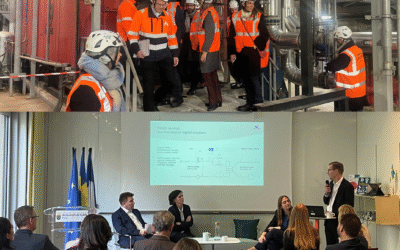
A new £25 million Heat Decarbonisation Fund has been launched to accelerate the transition from fossil fuel heating to low-carbon alternatives along the River Clyde corridor. The initiative, part of the £40 million Scottish Government investment in the Clyde Mission programme, was announced at the Queens Quay Energy Centre in Clydebank, with local leaders touring the facility to see Scotland’s first major water source heat pump in action. The heat pump draws energy from the River Clyde and supplies nearby homes and businesses via a district heating network.
The fund will provide capital grants to support the creation or upgrade of district heating networks and other clean energy projects, helping the region reduce carbon emissions, improve energy security, promote economic growth, and reduce energy poverty. The Clyde corridor is home to over 100.000 residents, 160.000 jobs, and 6.600 businesses, but faces challenges from de-industrialisation and derelict land. Led by Glasgow City Region and Argyll and Bute Council, the Clyde Mission Programme aims to revitalise the area.
The Heat Decarbonisation Fund is now live, with applications for the first phase closing in February 2026 and successful projects confirmed in March. By investing in district heating and renewable energy, the fund represents a major step toward a cleaner, greener, and fairer future for communities along the River Clyde.
Read more in article from Project Scotland
To stay updated on news for sustainable heating and cooling, follow us on LinkedIn, and subscribe to our Newsletter.
Sweden is at the forefront of decentralised heat networks technology. Our aim for “Sustainable Heating & Cooling by Sweden” is to facilitate knowledge sharing between British, French and Swedish stakeholders and develop and encourage environmental and economic best practice.
To find out how we can help you and your organisation, please contact our London or Paris-based “SHC” teams. We can introduce you to leading consultants, suppliers of technology and services who will be pleased to share know-how of the development of sustainable heating & cooling solutions.