
SHC by Sweden concludes a successful year in France with conference and Paris site visit • An economic zone development in Nîmes to feature integrated DHC network • Amorce proposes funding and policy measures to expand DHC networks • Read more about the developments in sustainable heating and cooling in this month's news update from France



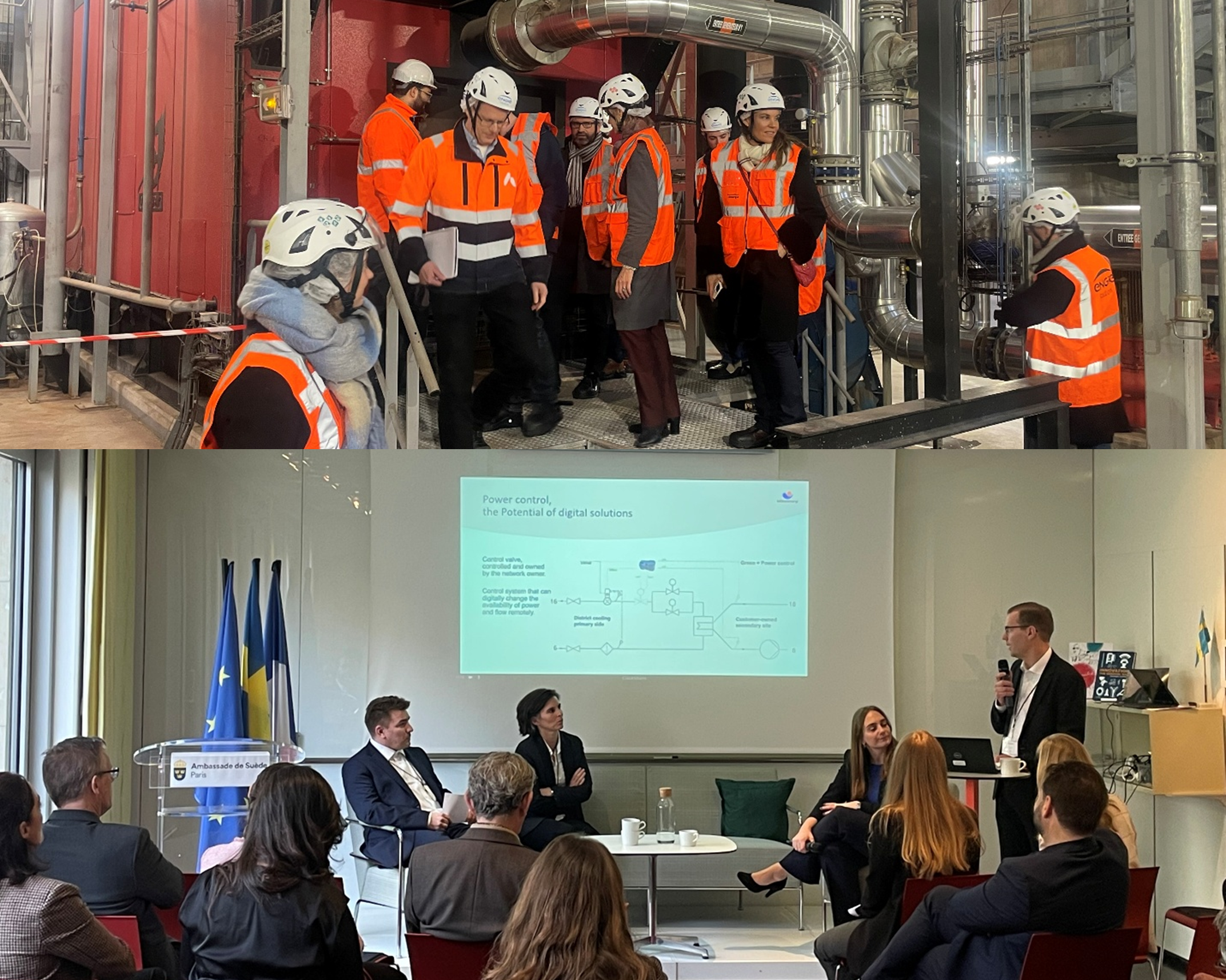
On 26 November, the 4th Annual French–Swedish Conference on Heating and Cooling Collaboration brought together industry leaders, policymakers, and technology providers to explore the future of sustainable energy solutions. Organised by Sustainable Heating & Cooling (SHC) by Sweden, comprising Business Sweden, the Swedish Energy Agency, and SweHeat, in partnership with the Swedish Embassy in France, the event featured keynote presentations, thematic workshops, and a B2B networking session.
The conference centred on two main themes:
The conference also included a B2B segment, hosted at the Swedish Ambassador’s residence, providing an informal setting with a buffet for Swedish and French companies to exchange expertise and explore collaboration opportunities. This session reinforced the shared ambition to accelerate innovation in heating and cooling technologies.
In addition to the conference, the Swedish delegation visited Engie’s biomass district heating plant in Gennevilliers. The visit included a tour to see the site’s two biomass boilers, the wood-chip fuel reception area, and a demonstration of demand and supply management systems from the site’s control offices. At the start of the visit, delegates engaged in a detailed discussion with the site manager and an Engie Solutions executive. One of the main topics discussed included a comparison between the French concession model and Sweden’s predominantly municipal-managed systems, as well as the opportunities for district heating solutions over coming years in the wake of the strong momentum behind district heating network expansion across France from 2025-2035.
The visit and conference underscored France’s ambitious plans for DHC development and the shared commitment of France and Sweden to advancing sustainable energy solutions. Once again, the SHC activities highlighted the importance of cross-border collaboration to drive sustainable progress for energy markets in Europe.
Magna Porta, a planned economic activity zone near Nîmes, will include a district heating and cooling network designed to optimise energy use across the site. The project was announced on 10 December at the EnerGaïa renewable energy forum in Montpellier by construction company NGE and the Regional Energy and Climate Agency of Occitanie (AREC).
The network will serve the 68-hectare development located close to the Nîmes-Pont du Gard high-speed rail station in Manduel. It is intended to provide heating and cooling for businesses within the zone through a combination of technologies. Heat generated by the data centre will be recovered and reused, geothermal systems will supply heating and cooling, and photovoltaic installations will generate electricity to power the network. Solar panels will be installed on rooftops and under canopies throughout the site.
A dedicated company will be created by NGE and AREC to manage the system. Its responsibilities will include overseeing energy production and distribution, maintaining overall efficiency, and reinjecting surplus energy to improve autonomy.
The heating and cooling network forms part of a wider investment programme for Magna Porta, which totals more than 500 million EUR. Of this amount, approximately 300 million EUR is allocated to the data centre and 30 million EUR to energy infrastructure. The development will provide 200,000 square metres of floor space and is expected to support over 2,000 direct and indirect jobs. Initial buildings are scheduled for completion between late 2028 and early 2029. Around 70 per cent of the first three quadrants have already been pre-commercialised.
Magna Porta will include four distinct areas for industrial, innovation, tertiary and service activities. NGE, the fourth-largest construction group in France, is working with its real estate division and regional teams as a strategic partner to Nîmes Métropole on the design and delivery of the project.
The district heating and cooling network is intended to reduce reliance on external energy sources and provide a stable supply for businesses operating within the zone. By combining heat recovery, geothermal systems and solar power, the system aims to deliver consistent performance across the site.
Read more in article from Objectif Gard
The SHC by Sweden team summarises recent policy discussions and proposals presented by the association Amorce regarding the development of district heating and cooling networks in France. These policy recommendations were shared by Amorce during the 21st edition of the Rencontres des réseaux de chaleur et de froid, with the aim of meeting targets set by the multi-year energy programme (PPE).
Amorce, created in 1987, is the first French network dedicated to providing information, sharing experiences and supporting local authorities and stakeholders in areas such as energy transition, waste management, circular economy and sustainable water management.
In France, approximately 16.9 million primary residences rely on heating systems. Of these, more than eight million use individual systems powered mainly by gas and electricity. Collective heating remains limited, with around 650 000 homes currently connected to district heating networks. According to PPE objectives, this figure should rise to 4.1 million by 2035. To address this gap, Amorce is calling for an increase in the budget for the Fonds Chaleur, proposing that it would beneficial if it could reach 2.5 billion EUR by 2026.
Amorce also recommends changes to energy taxation to improve the competitiveness of renewable sources. Its proposals include reducing electricity tax by 3 EUR per megawatt-hour and increasing gas tax by 4.40 EUR per megawatt-hour. These adjustments aim to encourage a shift towards renewable energy and maintain the competitiveness of low-carbon solutions compared to fossil fuels.
The association also supports the introduction of a reduced VAT rate for cooling networks, a measure already approved by the Senate. This initiative is intended to facilitate the development of renewable cooling infrastructure, which is increasingly in demand due to rising temperatures.
Furthermore, Amorce advocates prioritising collective heating in multi-unit buildings, considering it the most efficient and sustainable option. It recommends adopting low-temperature heating solutions, below 45°C, to improve the efficiency of local renewable resources.
Finally, the organisation encourages local authorities to implement heat and cooling plans to map energy needs and available resources. According to Amorce, such an approach aims to ensure balanced development of networks across different regions.
Read more in article from Le Bâtimant Performant
To stay updated on news for sustainable heating and cooling, follow us on LinkedIn, and subscribe to our Newsletter.
Sweden is at the forefront of decentralised heat networks technology. Our aim for “Sustainable Heating & Cooling by Sweden” is to facilitate knowledge sharing between British, French and Swedish stakeholders and develop and encourage environmental and economic best practice.
To find out how we can help you and your organisation, please contact our London or Paris-based “SHC” teams. We can introduce you to leading consultants, suppliers of technology and services who will be pleased to share know-how of the development of sustainable heating & cooling solutions.